
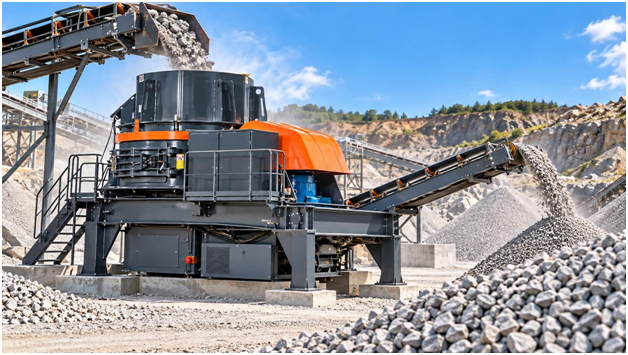
In the aggregates industry, particle shape and consistency matter as much as size. Cubical, well-graded material performs better in concrete, asphalt and road base than flaky or elongated particles. Many plants therefore add a final-stage machine specifically designed to improve shape and produce manufactured sand.
A VSI Crusher is that machine. It uses high-speed impact rather than compression to fracture rock, delivering the cubical product that modern specifications demand.
How a Vertical Shaft Impact Crusher Works
Material enters the top of the machine and drops into the centre of a rapidly spinning rotor. Centrifugal force accelerates the particles and flings them outward at high velocity. They then collide either with a bed of the same rock lining the crushing chamber (rock-on-rock) or with fixed anvils (rock-on-steel).
The high-energy impacts break the particles along natural planes of weakness. Because the energy is applied suddenly and from multiple directions, the resulting fragments tend to be more cubical and less elongated than those produced by compression crushers. Rotor speed is the main control: higher tip speeds generally produce more fines and a finer product, while lower speeds favour coarser, still well-shaped aggregate.
Most VSI units operate as tertiary or quaternary crushers. Feed is normally limited to around 40–55 mm, depending on the model and material. The machine can run in open circuit for shaping or closed circuit with screening when tight grading or a high sand yield is required.
Why Particle Shape Matters
Concrete and asphalt mixes work better with cubical aggregate. Rounded or flaky particles can reduce interlock, increase water demand and lower strength. Manufactured sand produced by vertical shaft impact crushing often shows better particle shape and lower clay content than many natural sands, helping producers meet strict grading and quality standards for roads, bridges and high-performance concrete.
The same process is useful for recycling concrete, glass and slag, and for processing certain industrial minerals where a controlled, cubical product is needed.
Key Factors When Considering a VSI Crusher
Selecting and operating a VSI successfully depends on several practical points:
- Feed size and consistency – oversized or poorly prepared feed increases wear and reduces throughput.
- Material abrasiveness – harder, more abrasive rock raises wear rates on rotor tips and chamber liners, so wear-part costs must be factored into the operating budget.
- Desired product – decide early whether the priority is manufactured sand, reshaped coarse aggregate, or both; rotor speed and circuit configuration will differ.
- Power and capacity – match motor size and rotor diameter to the required tonnage and feed characteristics.
- Maintenance access – look for designs that allow quick, safe replacement of wear parts to keep downtime low.
- Circuit design – closed-circuit operation with screens gives tighter control over final grading but adds capital and energy cost.
Professional advice from experienced process engineers is often useful when sizing the machine, choosing between rock-on-rock and rock-on-steel configurations, or integrating the unit into an existing plant.
Practical Operating Considerations
Wear parts are the largest ongoing cost. Rock-on-rock designs typically consume fewer metal parts because the rock bed protects the chamber, although they may require careful feed control to maintain the bed. Regular inspection of rotor tips, liners and bearings, combined with proper lubrication, extends component life.
Dust control and noise management are important. Enclosure, water sprays or dust extraction systems help meet environmental requirements. Vibration should be monitored; excessive vibration usually points to imbalance, uneven wear or feed problems.
Because product shape and grading respond directly to rotor speed, operators often adjust speed to meet changing market needs without changing screens or other equipment. This flexibility is one of the practical advantages of the technology.
Common Issues and How to Avoid Them
Poor feed preparation is the most frequent source of problems. Material that is too large, too wet or contaminated with clay can cause bridging, accelerated wear or inconsistent product. Proper screening and, where necessary, washing ahead of the VSI prevent most of these issues.
Another common difficulty is over-production of ultra-fines when the machine is run too fast for the required product. Careful speed selection and closed-circuit control keep the grading within specification.
When the application involves highly abrasive rock or very high utilisation, total cost of ownership should be calculated carefully. In some cases a different tertiary crusher may prove more economical; in others the superior product shape from a VSI justifies the operating cost.
Conclusion
A VSI Crusher delivers high-quality, cubical aggregates and manufactured sand through controlled high-speed impact. Its ability to improve particle shape after primary and secondary crushing makes it a valuable tool for producers supplying concrete, asphalt and specialised construction materials.
When evaluating the technology, focus on feed preparation, wear costs, product requirements and circuit design. Matching these factors to the specific application, and seeking experienced process advice where needed, gives the best chance of reliable performance and consistent product quality.